Saturday, January 11, 2014

Friday, September 28, 2012
Adolf Hitler: Biography
Adolf Hitler

(1889-1945)
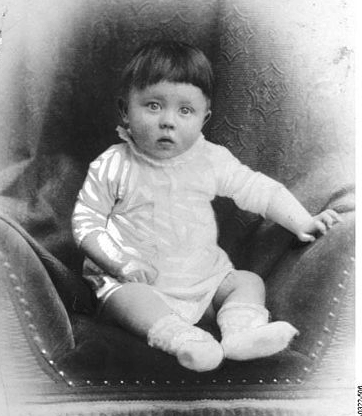
Klara Hitler was Alois' third wife. Alois was twenty-three years older than Klara and already had two children from his previous marriages. Klara and Alois had five children but only Adolf and a younger sister, Paula, survived to become adults.
Alois, who was fifty-one when Adolf was born, was extremely keen for his son to do well in life. Alois did have another son by an earlier marriage but he had been a big disappointment to him and eventually ended up in prison for theft. Alois was a strict father and savagely beat his son if he did not do as he was told.
World War I
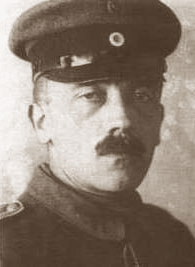 |
In May 1913 Hitler left Vienna for Munich and, when war broke out in August 1914, he joined the Sixteenth Bavarian Infantry Regiment, serving as a despatch runner. Hitler proved an able, courageous soldier, receiving the Iron Cross (First Class) for bravery, but did not rise above the rank of Lance Corporal. Twice wounded, he was badly gassed four weeks before the end of the war and spent three months recuperating in a hospital in Pomerania. Temporarily blinded and driven to impotent rage by the abortive November 1918 revolution in Germany as well as the military defeat, Hitler, once restored, was convinced that fate had chosen him to rescue a humiliated nation from the shackles of the Versailles Treaty, from Bolsheviks and Jews.Assigned by the Reichswehr in the summer of 1919 to "educational" duties which consisted largely of spying on political parties in the overheated atmosphere of post-revolutionary Munich, Hitler was sent to investigate a small nationalistic group of idealists, the German Workers' Party. On 16 September 1919 he entered the Party (which had approximately forty members), soon changed its name to the National Socialist German Workers' Party (NSDAP) and had imposed himself as its Chairman by July 1921.
Hitler Becomes a Leader
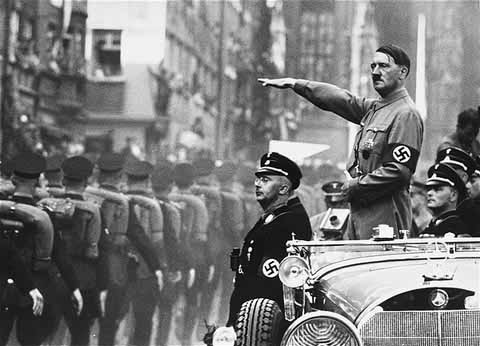
Hitler discovered a powerful talent for oratory as well as giving the new Party its symbol — the swastika — and its greeting "Heil!." His hoarse, grating voice, for all the bombastic, humourless, histrionic content of his speeches, dominated audiences by dint of his tone of impassioned conviction and gift for self-dramatization. By November 1921 Hitler was recognized as Fuhrer of a movement which had 3,000 members, and boosted his personal power by organizing strong- arm squads to keep order at his meetings and break up those of his opponents. Out of these squads grew the storm troopers (SA) organized by Captain Ernst Röhm and Hitler's black-shirted personal bodyguard, the Schutzstaffel (SS).Hitler focused his propaganda against the Versailles Treaty, the "November criminals," the Marxists and the visible, internal enemy No. 1, the "Jew," who was responsible for all Germany's domestic problems. In the twenty-five-point programme of the NSDAP announced on 24 February 1920, the exclusion of the Jews from the Volk community, the myth of Aryan race supremacy and extreme nationalism were combined with "socialistic" ideas of profit-sharing and nationalization inspired by ideologues like Gottfried Feder. Hitler's first written utterance on political questions dating from this period emphasized that what he called "the anti-Semitism of reason" must lead "to the systematic combating and elimination of Jewish privileges. Its ultimate goal must implacably be the total removal of the Jews."
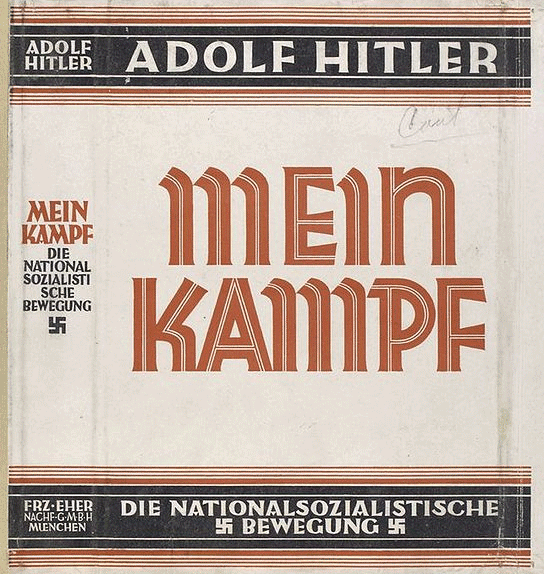 |
By November 1923 Hitler was convinced that the Weimar Republic was on the verge of collapse and, together with General Ludendorff and local nationalist groups, sought to overthrow the Bavarian government in Munich. Bursting into a beer-hall in Munich and firing his pistol into the ceiling, he shouted out that he was heading a new provisional government which would carry through a revolution against "Red Berlin." Hitler and Ludendorff then marched through Munich at the head of 3,000 men, only to be met by police fire which left sixteen dead and brought the attempted putsch to an ignominious end. Hitler was arrested and tried on 26 February 1924, succeeding in turning the tables on his accusers with a confident, propagandist speech which ended with the prophecy: "Pronounce us guilty a thousand times over: the goddess of the eternal court of history will smile and tear to pieces the State Prosecutor's submission and the court's verdict for she acquits us." Sentenced to five years' imprisonment in Landsberg fortress, Hitler was released after only nine months during which he dictated Mein Kampf (My Struggle) to his loyal follower, Rudolf Hess. Subsequently the "bible" of the Nazi Party, this crude, half-baked hotchpotch of primitive Social Darwinism, racial myth, anti-Semitism and lebensraum fantasy had sold over five million copies by 1939 and been translated into eleven languages.The failure of the Beer-Hall putsch and his period of imprisonment transformed Hitler from an incompetent adventurer into a shrewd political tactician, who henceforth decided that he would never again confront the gun barrels of army and police until they were under his command. He concluded that the road to power lay not through force alone but through legal subversion of the Weimar Constitution, the building of a mass movement and the combination of parliamentary strength with extra-parliamentary street terror and intimidation. Helped by Goering and Goebbels he began to reassemble his followers and rebuild the movement which had disintegrated in his absence.
Rise of the Nazi Party
In January 1925 the ban on the Nazi Party was removed and Hitler regained permission to speak in public. Outmaneuvering the "socialist" North German wing of the Party under Gregor Strasser, Hitler re-established himself in 1926 as the ultimate arbiter to whom all factions appealed in an ideologically and socially heterogeneous movement. Avoiding rigid, programmatic definitions of National Socialism which would have undermined the charismatic nature of his legitimacy and his claim to absolute leadership, Hitler succeeded in extending his appeal beyond Bavaria and attracting both Right and Left to his movement.Though the Nazi Party won only twelve seats in the 1928 elections, the onset of the Great Depression with its devastating effects on the middle classes helped Hitler to win over all those strata in German society who felt their economic existence was threatened. In addition to peasants, artisans, craftsmen, traders, small businessmen, ex-officers, students and declasse intellectuals, the Nazis in 1929 began to win over the big industrialists, nationalist conservatives and army circles. With the backing of the press tycoon, Alfred Hugenberg, Hitler received a tremendous nationwide exposure just as the effects of the world economic crisis hit Germany, producing mass unemployment, social dissolution, fear and indignation. With demagogic virtuosity, Hitler played on national resentments, feelings of revolt and the desire for strong leadership using all the most modern techniques of mass persuasion to present himself as Germany's redeemer and messianic saviour.
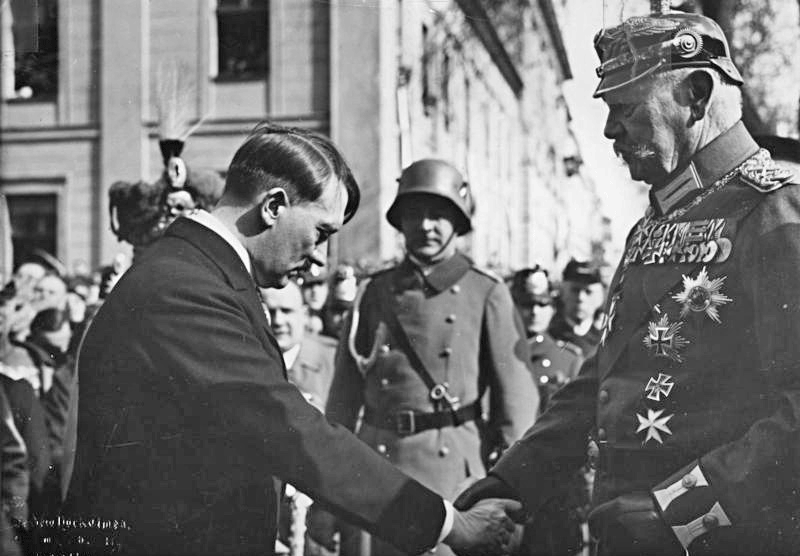 |
In the 1930 elections the Nazi vote jumped dramatically from 810,000 to 6,409,000 (18.3 percent of the total vote) and they received 107 seats in the Reichstag. Prompted by Hjalmar Schacht and Fritz Thyssen, the great industrial magnates began to contribute liberally to the coffers of the NSDAP, reassured by Hitler's performance before the Industrial Club in Dusseldorf on 27 January 1932 that they had nothing to fear from the radicals in the Party. The following month Hitler officially acquired German citizenship and decided to run for the Presidency, receiving 13,418,011 votes in the run-off elections of 10 April 1931 as against 19,359,650 votes for the victorious von Hindenburg , but four times the vote for the communist candidate, Ernst Thaelmann. In the Reichstag elections of July 1932 the Nazis emerged as the largest political party in Germany, obtaining nearly fourteen million votes (37.3 per cent) and 230 seats. Although the NSDAP fell back in November 1932 to eleven million votes (196 seats), Hitler was helped to power by a camarilla of conservative politicians led by Franz von Papen, who persuaded the reluctant von Hindenburg to nominate "the Bohemian corporal" as Reich Chancellor on 30 January 1933.Once in the saddle, Hitler moved with great speed to outmanoeuvre his rivals, virtually ousting the conservatives from any real participation in government by July 1933, abolishing the free trade unions, eliminating the communists, Social Democrats and Jews from any role in political life and sweeping opponents into concentration camps. The Reichstag fire of 27 February 1933 had provided him with the perfect pretext to begin consolidating the foundations of a totalitarian one-party State, and special "enabling laws" were ramrodded through the Reichstag to legalize the regime's intimidatory tactics.With support from the nationalists, Hitler gained a majority at the last "democratic" elections held in Germany on 5 March 1933 and with cynical skill he used the whole gamut of persuasion, propaganda, terror and intimidation to secure his hold on power. The seductive notions of "National Awakening" and a "Legal Revolution" helped paralyse potential opposition and disguise the reality of autocratic power behind a facade of traditional institutions.
Hitler As Fuhrer
 |
The destruction of the radical SA leadership under Ernst Rohm in the Blood Purge of June 1934 confirmed Hitler as undisputed dictator of the Third Reich and by the beginning of August, when he united the positions of Fuhrer and Chancellor on the death of von Hindenburg, he had all the powers of State in his hands. Avoiding any institutionalization of authority and status which could challenge his own undisputed position as supreme arbiter, Hitler allowed subordinates like Himmler, Goering and Goebbels to mark out their own domains of arbitrary power while multiplying and duplicating offices to a bewildering degree.During the next four years Hitler enjoyed a dazzling string of domestic and international successes, outwitting rival political leaders abroad just as he had defeated his opposition at home. In 1935 he abandoned the Versailles Treaty and began to build up the army by conscripting five times its permitted number. He persuaded Great Britain to allow an increase in the naval building programme and in March 1936 he occupied the demilitarized Rhineland without meeting opposition. He began building up the Luftwaffe and supplied military aid to Francoist forces in Spain, which brought about the Spanish fascist victory in 1939.The German rearmament programme led to full employment and an unrestrained expansion of production, which reinforced by his foreign policy successes--the Rome-Berlin pact of 1936, the Anschluss with Austria and the "liberation" of the Sudeten Germans in 1938 — brought Hitler to the zenith of his popularity. In February 1938 he dismissed sixteen senior generals and took personal command of the armed forces, thus ensuring that he would be able to implement his aggressive designs.Hitler's saber-rattling tactics bludgeoned the British and French into the humiliating Munich agreement of 1938 and the eventual dismantlement of the Czechoslovakian State in March 1939. The concentration camps, the Nuremberg racial laws against the Jews, the persecution of the churches and political dissidents were forgotten by many Germans in the euphoria of Hitler's territorial expansion and bloodless victories. The next designated target for Hitler's ambitions was Poland (her independence guaranteed by Britain and France) and, to avoid a two-front war, the Nazi dictator signed a pact of friendship and non-aggression with Soviet Russia.
World War II
On September 1, 1939, German armed forces invaded Poland and henceforth Hitler's main energies were devoted to the conduct of a war he had unleashed to dominate Europe and secure Germany's "living space."The first phase of World War II was dominated by German Blitzkrieg tactics: sudden shock attacks against airfields, communications, military installations, using fast mobile armor and infantry to follow up on the first wave of bomber and fighter aircraft. Poland was overrun in less than one month, Denmark and Norway in two months, Holland, Belgium, Luxemburg and France in six weeks. After the fall of France in June 1940 only Great Britain stood firm.
 |
The Battle of Britain, in which the Royal Air Force prevented the Luftwaffe from securing aerial control over the English Channel, was Hitler's first setback, causing the planned invasion of the British Isles to be postponed. Hitler turned to the Balkans and North Africa where his Italian allies had suffered defeats, his armies rapidly overrunning Greece, Yugoslavia, the island of Crete and driving the British from Cyrenaica.The crucial decision of his career, the invasion of Soviet Russia on June 22, 1941, was rationalized by the idea that its destruction would prevent Great Britain from continuing the war with any prospect of success. He was convinced that once he kicked the door in, as he told Jodl (q.v.), "the whole rotten edifice [of communist rule] will come tumbling down" and the campaign would be over in six weeks. The war against Russia was to be an anti-Bolshivek crusade, a war of annihilation in which the fate of European Jewry would finally be sealed. At the end of January 1939 Hitler had prophesied that "if the international financial Jewry within and outside Europe should succeed once more in dragging the nations into a war, the result will be, not the Bolshevization of the world and thereby the victory of Jewry, but the annihilation of the Jewish race in Europe."As the war widened — the United States by the end of 1941 had entered the struggle against the Axis powers — Hitler identified the totality of Germany's enemies with "international Jewry," who supposedly stood behind the British-American-Soviet alliance. The policy of forced emigration had manifestly failed to remove the Jews from Germany's expanded lebensraum, increasing their numbers under German rule as the Wehrmacht moved East.The widening of the conflict into a world war by the end of 1941, the refusal of the British to accept Germany's right to continental European hegemony (which Hitler attributed to "Jewish" influence) and to agree to his "peace" terms, the racial-ideological nature of the assault on Soviet Russia, finally drove Hitler to implement the "Final Solution of the Jewish Question" which had been under consideration since 1939. The measures already taken in those regions of Poland annexed to the Reich against Jews (and Poles) indicated the genocidal implications of Nazi-style "Germanization" policies. The invasion of Soviet Russia was to set the seal on Hitler's notion of territorial conquest in the East, which was inextricably linked with annihilating the 'biological roots of Bolshevism' and hence with the liquidation of all Jews under German rule.At first the German armies carried all before them, overrunning vast territories, overwhelming the Red Army, encircling Leningrad and reaching within striking distance of Moscow. Within a few months of the invasion Hitler's armies had extended the Third Reich from the Atlantic to the Caucasus, from the Baltic to the Black Sea. But the Soviet Union did not collapse as expected and Hitler, instead of concentrating his attack on Moscow, ordered a pincer movement around Kiev to seize the Ukraine, increasingly procrastinating and changing his mind about objectives. Underestimating the depth of military reserves on which the Russians could call, the caliber of their generals and the resilient, fighting spirit of the Russian people (whom he dismissed as inferior peasants), Hitler prematurely proclaimed in October 1941 that the Soviet Union had been "struck down and would never rise again." In reality he had overlooked the pitiless Russian winter to which his own troops were now condemned and which forced the Wehrmacht to abandon the highly mobile warfare which had previously brought such spectacular successes.The disaster before Moscow in December 1941 led him to dismiss his Commander-in-Chief von Brauchitsch, and many other key commanders who sought permission for tactical withdrawals, including Guderian, Bock, Hoepner, von Rundstedt and Leeb, found themselves cashiered. Hitler now assumed personal control of all military operations, refusing to listen to advice, disregarding unpalatable facts and rejecting everything that did not fit into his preconceived picture of reality. His neglect of the Mediterranean theatre and the Middle East, the failure of the Italians, the entry of the United States into the war, and above all the stubborn determination of the Russians, pushed Hitler on to the defensive. From the winter of 1941 the writing was on the wall but Hitler refused to countenance military defeat, believing that implacable will and the rigid refusal to abandon positions could make up for inferior resources and the lack of a sound overall strategy.Convinced that his own General Staff was weak and indecisive, if not openly treacherous, Hitler became more prone to outbursts of blind, hysterical fury towards his generals, when he did not retreat into bouts of misanthropic brooding. His health, too, deteriorated under the impact of the drugs prescribed by his quack physician, Dr. Theodor Morell. Hitler's personal decline, symbolized by his increasingly rare public appearances and his self-enforced isolation in the "Wolf's Lair," his headquarters buried deep in the East Prussian forests, coincided with the visible signs of the coming German defeat which became apparent in mid-1942.
Allied Victory and Hitler's Death
Rommel's defeat at El Alamein and the subsequent loss of North Africa to the Anglo-American forces were overshadowed by the disaster at Stalingrad where General von Paulus's Sixth Army was cut off and surrendered to the Russians in January 1943. In July 1943 the Allies captured Sicily and Mussolini's regime collapsed in Italy. In September the Italians signed an armistice and the Allies landed at Salerno, reaching Naples on 1 October and taking Rome on June 4, 1944. The Allied invasion of Normandy followed on June 6, 1944 and soon a million Allied troops were driving the German armies eastwards, while from the opposite direction the Soviet forces advanced relentlessly on the Reich. The total mobilization of the German war economy under Albert Speer and the energetic propaganda efforts of Joseph Goebbels to rouse the fighting spirit of the German people were impotent to change the fact that the Third Reich lacked the resources equal to a struggle against the world alliance which Hitler himself had provoked.
 |
Allied bombing began to have a telling effect on German industrial production and to undermine the morale of the population. The generals, frustrated by Hitler's total refusal to trust them in the field and recognizing the inevitability of defeat, planned, together with the small anti-Nazi Resistance inside the Reich, to assassinate the Fuhrer on 20 July 1944, hoping to pave the way for a negotiated peace with the Allies that would save Germany from destruction. The plot failed and Hitler took implacable vengeance on the conspirators, watching with satisfaction a film of the grisly executions carried out on his orders.As disaster came closer, Hitler buried himself in the unreal world of the Fuhrerbunker in Berlin, clutching at fantastic hopes that his "secret weapons," the V-1 and V-2 rockets, would yet turn the tide of war. He gestured wildly over maps, planned and directed attacks with non-existent armies and indulged in endless, night-long monologues which reflected his growing senility, misanthropy and contempt for the "cowardly failure" of the German people.As the Red Army approached Berlin and the Anglo-Americans reached the Elbe, on 19 March 1945 Hitler ordered the destruction of what remained of German industry, communications and transport systems. He was resolved that, if he did not survive, Germany too should be destroyed. The same ruthless nihilism and passion for destruction which had led to the extermination of six million Jews in death camps, to the biological "cleansing" of the sub-human Slavs and other subject peoples in the New Order, was finally turned on his own people.On April 29, 1945, he married his mistress Eva Braun and dictated his final political testament, concluding with the same monotonous, obsessive fixation that had guided his career from the beginning: "Above all I charge the leaders of the nation and those under them to scrupulous observance of the laws of race and to merciless opposition to the universal poisoner of all peoples, international Jewry."The following day Hitler committed suicide, shooting himself through the mouth with a pistol. His body was carried into the garden of the Reich Chancellery by aides, covered with petrol and burned along with that of Eva Braun. This final, macabre act of self-destruction appropriately symbolized the career of a political leader whose main legacy to Europe was the ruin of its civilization and the senseless sacrifice of human life for the sake of power and his own commitment to the bestial nonsense of National Socialist race mythology. With his death nothing was left of the "Greater Germanic Reich," of the tyrannical power structure and ideological system which had devastated Europe during the twelve years of his totalitarian rule.
Thursday, September 27, 2012
History of Pakistan

Pakistan's Islamic history began with the arrival of Muslim traders in the 8th century in Sindh. The collapse of the Mughal Empire in the 18th century provided an opportunity to the English East India Company to extend its control over much of the subcontinent. In the west in the territory of modern Pakistan, the Sikh adventurer Ranjit Singh carved out a dominion that extended from Kabul to Srinagar and Lahore. British rule replaced the Sikhs in the first half of the 19th century. In a decision that had far-reaching consequences, the British permitted the Hindu Maharaja of Kashmir, a Sikh appointee, to continue in power.
Pakistan emerged over an extended period of agitation by many Muslims in the subcontinent to express their national identity free from British colonial domination as well as domination by what they perceived as a Hindu-controlled Indian National Congress. Muslim anti-colonial leaders formed the All-India Muslim League in 1906. Initially, the League adopted the same objective as the Congress--self-government for India within the British Empire--but Congress and the League were unable to agree on a formula that would ensure the protection of Muslim religious, economic, and political rights.
Pakistan and Partition
The idea of a separate Muslim state emerged in the 1930s. On March 23, 1940, Muhammad Ali Jinnah, leader of the Muslim League, formally endorsed the "Lahore Resolution," calling for the creation of an independent state in regions where Muslims constituted a majority. At the end of World War II, the United Kingdom moved with increasing urgency to grant India independence. The Congress Party and the Muslim League, however, could not agree on the terms for a Constitution or establishing an interim government. In June 1947, the British Government declared that it would bestow full dominion status upon two successor states--India and Pakistan, formed from areas in the subcontinent in which Muslims were the majority population. Under this arrangement, the various princely states could freely join either India or Pakistan. Accordingly, on August 14, 1947 Pakistan, comprising West Pakistan with the provinces of Punjab, Sindh, Balochistan, and the Northwest Frontier Province (NWFP), and East Pakistan with the province of Bengal, became independent. East Pakistan later became the independent nation of Bangladesh.
The Maharaja of Kashmir was reluctant to make a decision on accession to either Pakistan or India. However, armed incursions into the state by tribesman from the NWFP led him to seek military assistance from India. The Maharaja signed accession papers in October 1947 and allowed Indian troops into much of the state. The Government of Pakistan, however, refused to recognize the accession and campaigned to reverse the decision. The status of Kashmir has remained in dispute.
After Independence
With the death in 1948 of its first head of state, Muhammad Ali Jinnah, and the assassination in 1951 of its first prime minister, Liaqat Ali Khan, political instability and economic difficulty became prominent features of post-independence Pakistan. On October 7, 1958, President Iskander Mirza, with the support of the army, suspended the 1956 Constitution, imposed martial law, and canceled the elections scheduled for January 1959. Twenty days later the military sent Mirza into exile in Britain, and Gen. Mohammad Ayub Khan assumed control of a military dictatorship. After Pakistan's loss in the 1965 war against India, Ayub Khan's power declined. Subsequent political and economic grievances inspired agitation movements that compelled his resignation in March 1969. He handed over responsibility for governing to the commander in chief of the army, General Agha Mohammed Yahya Khan, who became President and Chief Martial Law Administrator.
General elections held in December 1970 polarized relations between the eastern and western sections of Pakistan. The Awami League, which advocated autonomy for the more populous East Pakistan, swept the East Pakistan seats to gain a majority in Pakistan as a whole. The Pakistan Peoples Party (PPP), founded and led by Ayub Khan's former Foreign Minister Zulfikar Ali Bhutto, won a majority of the seats in West Pakistan, but the country was completely split with neither major party having any support in the other area. Negotiations to form a coalition government broke down, and a civil war ensued. India attacked East Pakistan and captured Dhaka in December 1971, when the eastern section declared itself the independent nation of Bangladesh. Yahya Khan then resigned the presidency and handed over leadership of the western part of Pakistan to Bhutto, who became President and the first civilian Chief Martial Law Administrator.
Bhutto moved decisively to restore national confidence and pursued an active foreign policy, taking a leading role in Islamic and Third World forums. Although Pakistan did not formally join the Non-Aligned Movement until 1979, the position of the Bhutto government coincided largely with that of the non-aligned nations. Domestically, Bhutto pursued a populist agenda and nationalized major industries and the banking system. In 1973, he promulgated a new Constitution accepted by most political elements and relinquished the presidency to become prime minister. Although Bhutto continued his populist and socialist rhetoric, he increasingly relied on Pakistan's urban industrialists and rural landlords. Over time the economy stagnated, largely as a result of the dislocation and uncertainty produced by Bhutto's frequently changing economic policies. When Bhutto proclaimed his own victory in the March 1977 national elections, the opposition Pakistan National Alliance (PNA) denounced the results as fraudulent and demanded new elections. Bhutto resisted and later arrested the PNA leadership.
1977-1985 Martial Law
With increasing anti-government unrest, the army grew restive. On July 5, 1977, the military removed Bhutto from power and arrested him, declared martial law, and suspended portions of the 1973 Constitution. Chief of Army Staff Gen. Muhammad Zia ul-Haq became Chief Martial Law Administrator and promised to hold new elections within 3 months.
Zia released Bhutto and asserted that he could contest new elections scheduled for October 1977. However, after it became clear that Bhutto's popularity had survived his government, Zia postponed the elections and began criminal investigations of the senior PPP leadership. Subsequently, Bhutto was convicted and sentenced to death for alleged conspiracy to murder a political opponent. Despite international appeals on his behalf, Bhutto was hanged on April 6, 1979.
Zia assumed the presidency and called for elections in November. However, fearful of a PPP victory, Zia banned political activity in October 1979 and postponed national elections.
In 1980, most center and left parties, led by the PPP, formed the Movement for the Restoration of Democracy (MRD). The MRD demanded Zia's resignation, an end to martial law, new elections, and restoration of the Constitution as it existed before Zia's takeover. In early December 1984, President Zia proclaimed a national referendum for December 19 on his "Islamization" program. He implicitly linked approval of "Islamization" with a mandate for his continued presidency. Zia's opponents, led by the MRD, boycotted the elections. When the government claimed a 63% turnout, with more than 90% approving the referendum, many observers questioned these figures.
1988-2002
On August 17, 1988, a plane carrying President Zia, American Ambassador Arnold Raphel, U.S. Brig. General Herbert Wassom, and 28 Pakistani military officers crashed on a return flight from a military equipment trial near Bahawalpur, killing all of its occupants. In accordance with the Constitution, Chairman of the Senate Ghulam Ishaq Khan became Acting President and announced that elections scheduled for November 1988 would take place.
After winning 93 of the 205 National Assembly seats contested, the PPP, under the leadership of Benazir Bhutto, formed a coalition government with several smaller parties, including the Muhajir Qaumi Movement (MQM). The Islamic Democratic Alliance (IJI), a multi-party coalition led by the PML and including religious right parties such as the Jamaat-i-Islami (JI), won 55 National Assembly seats.
Differing interpretations of constitutional authority, debates over the powers of the central government relative to those of the provinces, and the antagonistic relationship between the Bhutto administration and opposition governments in Punjab and Balochistan seriously impeded social and economic reform programs. Ethnic conflict, primarily in Sindh province, exacerbated these problems. A fragmentation in the governing coalition and the military's reluctance to support an apparently ineffectual and corrupt government were accompanied by a significant deterioration in law and order.
In August 1990, President Khan, citing his powers under the eighth amendment to the Constitution, dismissed the Bhutto government and dissolved the national and provincial assemblies. New elections, held in October 1990, confirmed the political ascendancy of the IJI. In addition to a two-thirds majority in the National Assembly, the alliance acquired control of all four provincial parliaments and enjoyed the support of the military and of President Khan. Muhammad Nawaz Sharif, as leader of the PML, the most prominent Party in the IJI, was elected prime minister by the National Assembly.
Sharif emerged as the most secure and powerful Pakistani prime minister since the mid-1970s. Under his rule, the IJI achieved several important political victories. The implementation of Sharif's economic reform program, involving privatization, deregulation, and encouragement of private sector economic growth, greatly improved Pakistan's economic performance and business climate. The passage into law in May 1991 of a Shari'a bill, providing for widespread Islamization, legitimized the IJI government among much of Pakistani society.
However, Nawaz Sharif was not able to reconcile the different objectives of the IJI's constituent parties. The largest religious party, Jamaat-i-Islami (JI), abandoned the alliance because of its perception of PML hegemony. The regime was weakened further by the military's suppression of the MQM, which had entered into a coalition with the IJI to contain PPP influence and allegations of corruption directed at Nawaz Sharif. In April 1993, President Khan, citing "maladministration, corruption, and nepotism" and espousal of political violence, dismissed the Sharif government, but the following month the Pakistan Supreme Court reinstated the National Assembly and the Nawaz Sharif government. Continued tensions between Sharif and Khan resulted in governmental gridlock and the Chief of Army Staff brokered an arrangement under which both the President and the Prime Minister resigned their offices in July 1993.
An interim government, headed by Moeen Qureshi, a former World Bank Vice President, took office with a mandate to hold national and provincial parliamentary elections in October. Despite its brief term, the Qureshi government adopted political, economic, and social reforms that generated considerable domestic support and foreign admiration.
In the October 1993 elections, the PPP won a plurality of seats in the National Assembly, and Benazir Bhutto was asked to form a government. However, because it did not acquire a majority in the National Assembly, the PPP's control of the government depended upon the continued support of numerous independent parties, particularly the PML/J. The unfavorable circumstances surrounding PPP rule--the imperative of preserving a coalition government, the formidable opposition of Nawaz Sharif's PML/N movement, and the insecure provincial administrations--presented significant difficulties for the government of Prime Minister Bhutto. However, the election of Prime Minister Bhutto's close associate, Farooq Leghari, as President in November 1993 gave her a stronger power base.
In November 1996, President Leghari dismissed the Bhutto government, charging it with corruption, mismanagement of the economy, and implication in extrajudicial killings in Karachi. Elections in February 1997 resulted in an overwhelming victory for the PML/Nawaz, and President Leghari called upon Nawaz Sharif to form a government. In March 1997, with the unanimous support of the National Assembly, Sharif amended the Constitution, stripping the President of the power to dismiss the government and making his power to appoint military service chiefs and provincial governors contingent on the "advice" of the Prime Minister. Another amendment prohibited elected members from "floor crossing" or voting against party lines. The Sharif government engaged in a protracted dispute with the judiciary, culminating in the storming of the Supreme Court by ruling party loyalists and the engineered dismissal of the Chief Justice and the resignation of President Leghari in December 1997.
The new President elected by Parliament, Rafiq Tarar, was a close associate of the Prime Minister. A one-sided anti-corruption campaign was used to target opposition politicians and critics of the regime. Similarly, the government moved to restrict press criticism and ordered the arrest and beating of prominent journalists. As domestic criticism of Sharif's administration intensified, Sharif attempted to replace Chief of Army Staff General Pervez Musharraf on October 12, 1999, with a family loyalist, Director General ISI Lt. Gen. Ziauddin. Although General Musharraf was out of the country at the time, the army moved quickly to depose Sharif.
Following the October 12 ouster of the government of Prime Minister Sharif, the military-led government stated its intention to restructure the political and electoral systems. On October 14, 1999, General Musharraf declared a state of emergency and issued the Provisional Constitutional Order (PCO), which suspended the federal and provincial Parliaments, held the Constitution in abeyance, and designated Musharraf as Chief Executive. Musharraf appointed an eight-member National Security Council to function as Pakistan's supreme governing body, with mixed military/civilian appointees; a civilian Cabinet; and a National Reconstruction Bureau (think tank) to formulate structural reforms. On May 12, 2000, Pakistan's Supreme Court unanimously validated the October 1999 coup and granted Musharraf executive and legislative authority for 3 years from the coup date. On June 20, 2001, Musharraf named himself as president and was sworn in.
After the World Trade Center and the Pentagon were attacked on September 11, 2001, Musharraf pledged complete cooperation with the United States in its war on terror, which included locating and shutting down terrorist training camps within its borders and cracking down on extremist groups. This policy was highly unpopular with many Pakistani citizens, and the country was, for a while, plagued by popular demonstrations. However, in a referendum held on April 30, 2002, Musharraf's presidency was extended by 5 more years.
History Of PIA
Photo
Gallery of PIA's Finest Men and Women

Air
Marshal Malik Nur Khan (Abbas
Ali Collection)
|
In
this photo from 1960, PIA's very first jetliner (a Boeing
707-321 leased from Pan Am) is taking gentle turn under the
command of Malik Nur Khan. Nur Khan was PIA's Managing Director
from 1959 to 1965. His success in establishing PIA on a firm and
profitable financial basis in six years is now a fact of airline
history. Under his charismatic and inspirational leadership PIA
became one of the leading and respected airlines of the world.
Under his tenure PIA became the first Asian airline to operate
jet aircraft. The airline inducted modern Boeing 720B jet in its
fleet. PIA started flying to China and flights to Europe via
Moscow were also launched during this period. In 1973 Nur Khan
was specially requested by the government of Pakistan to resume
control of PIA. During his second stint at PIA as airline's
Chairman from 1973 to 1978, PIA
became operator of wide-body DC-10-30s and Boeing 747s. Nur Khan was
a dynamic leader and believed in innovation and new ideas and under
his
leadership PIA witnessed growth in passenger and freight traffic
and expanded route network. All-time popular Green & Gold PIA aircraft livery
was also introduced when Nur Khan was airline's Chairman. He
kept PIA out of Pakistan's turbulent political arena and
returned it to a sound commercial basis
|
 |
Air
Hostess Momi Gul Durrani (Abbas
Ali
Collection)
|
In
this photo PIA's famous Air Hostess Momi
Gul
Durrani is seen in airline's 1950s cabin crew uniform. Momi was
one of PIA's highly trained, professional and hard working cabin
crew members of 1950s and 1960s. She was tall, fair with
film-star looks. PIA had featured Momi in its many
advertisements and it is said that when she smiled, she made
others smile. In short period of time she gained immense
popularity and achieved status of a bright star and a legend in
PIA's glorious history. Momi was on duty aboard PIA Boeing 720B
jetliner which crashed near Cairo Airport on May 20, 1965.
Sadly, 114 people, including Momi, died in this tragic accident
|
 |
Capt.
Abdullah Baig and Capt. Taimur Baig (Copyright
© Aizaz
Moin)
|
This
photo is in the collection of Aizaz Moin. In this rare photo you
can see PIA pilots who flew airline's brand new Boeing 720-040B
(registration AP-AMG) on its record breaking delivery flight
from London to Karachi on January 2, 1962. The flight was
captained by Capt. Abdullah Baig. With representatives of FAI
(Federation Aeronautique International) on board to monitor the
official timings, AP-AMG completed the flight in 6 hours 43
minutes and 55 seconds, the record which to this day remains
unbroken!! This achievement symbolized the fledgling Pakistani
airline's fighting spirit and urge to reach the top. This photo
was taken soon after the arrival of record breaking flight at
Karachi Airport from London. In the photo you can see PIA's ace
pilot Captain Abdullah Baig (left) and his co-pilot Captain
Taimur Baig (right). In those days PIA's policy was to have 2
fully rated captains as pilot and co-pilot on jet flights. In
the background you can see the record breaking PIA Boeing 720B
(registration AP-AMG). This Boeing 720B jetliner was delivered
to PIA on December 21, 1961 at Seattle and flown by another crew
to London from where Captain Abdullah Baig took command and
broke the existing world speed record. On the left side of this
photo you can see Aizaz Moin's father Captain Moinuddin Quraishi.
Incidentally Capt. Taimur Baig was also Capt. Moinuddin
Quraishi's
co-pilot when he suffered a heart attack at Tehran in 1961.
Capt. Taimur took command and flew the Boeing 707-321
(registration N723PA) to Karachi. This Boeing 707 (registration
N723PA) was on lease from Pan Am and it had made PIA the first
Asian airline to fly jetliner. Capt. Moinuddin Quraishi was one
of the very first Pakistani pilots to fly jetliners
|
 |
From
left to right: First Officer Johnny Sadiq, Operations Officer
Hafeez and First Officer Baakza (Copyright
© Capt.
Johnny Sadiq)
|
This
rare photo was taken at Rawalpindi Airport in 1962. If you take
a closer look you can see a PIA DC-3 on take-off run in the
background
|
Tuesday, September 18, 2012
Ravindra Kaushik (1952-2001) the real ‘BLACK TIGER,’ a former RAW agent.
Ravindra Kaushik was
born in Sri Ganganagar, Rajasthan in the year 1952.He was a good
theater artist. During a national level drama presentation he came in
contact with RAW, the Indian intelligence agency. He completed his
graduation at the age of 23. After graduation
Ravindra Kaushik Joined RAW.
Black Tiger Background : He
was the 'Black Tiger' of RAW . Some say it was rewarded by India's then
home minister S.B. Chavan while others testify that the Title was
conferred by then Prime Minister, Indira Gandhi.
 | |||
| In 1983 he was caught and sentenced
to death for spying. Later his death sentence was converted into life
time imprisonment. India already fought with Pakistan and China.
Pakistan was preparing for another war against India. When Indian army
got this information, they sent
Ravindra Kaushik to Pakistan as Indian Spy with the help of RAW.
|
He was in Pakistan
Army from 1979 to 1983 and during this tenure he dispatched valuable
information to RAW which was of great help to the Indian defence
mechanism. But unfortunately Ravinder was caught by Pakistan. They put
him in jail where he was tortured. In the 1985 he was awarded death
sentence which was subsequently converted into life imprisonment.
Kaushik remained in various jails from where he somehow sent letters
which revealed the pathetic health condition and the trauma faced by him
in Pakistani jails. Ravinder Kaushik spent 18 years in Pakistani jails,
where he contracted Asthma and TB. He died on 21 November 2001 in a
jail at Mianwali. He was buried behind that jail.
He spend 30 years
of his life away from his home and family in Pakistan in very
unfavourable conditions, only because of his love for the Nation that is
India. Indian army killed more than 50 soldiers of Pakistani army in
Pahalgaon because they fought with the strategy send by Ravinder
Kaushik.
The
much hyped Salman Katrina starrer has gathered a lot of controvesy as
the promos draw a startling similarlity with this Former RAW agent’s
life story. Vikram Vashishtha, nephew of Late Ravinder Kaushik even
slammed a leagal notice to the production company. But the production
house & the director told the media that “Ek Tha Tiger” is not about
him.
Whatever the truth is now we do know who the real TIGER is. Kudos to Late Ravindra Kaushik, a real patriot of Mother land who even left his true Indentity behind to serve his nation.
Respect & Salute ! to the Black Tiger
Subscribe to:
Posts (Atom)